Visual QA Assistant: How edge AI and Qt change quality assurance

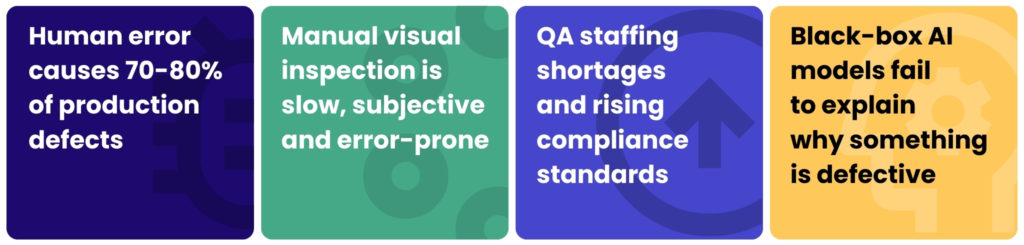
Manufacturing quality assurance has traditionally relied on simple indicators, such as red or green markers, heat maps, and visual inspection. These indicators very often leave operators guessing. While these systems can indicate that something is wrong, they rarely explain why the issue matters or how severe it is. Training can be time-consuming for new staff, and even experienced operators may have difficulty interpreting ambiguous visual cues.
This is where AI-powered visual inspection comes in. By combining real-time image analysis with machine learning, manufacturers can detect defects faster, more accurately, and with greater insight. However, detection alone is not enough – operators need understandable explanations. That’s why explainable AI and intuitive, operator-friendly interfaces are essential to transforming quality assurance from a static, opaque process into a dynamic, actionable one.
What is the Visual QA Assistant?
The Visual QA Assistant is an intelligent inspection module designed to address the most pressing quality assurance challenges in modern manufacturing. It transforms traditional QA from a static, guesswork-heavy process into a smart, operator-friendly experience by combining AI-powered defect detection, edge computing, and an intuitive Qt-based user interface.
This system is ideal for OEMs and integrators seeking to modernise their QA workflows with explainable AI and flexible, scalable technology. It provides actionable insights in real time, helping operators understand not only what is wrong but also why it matters. This information is displayed via clear visual overlays, natural language explanations, and optional voice feedback.

This is how it works in practice:
- It scans real physical parts using a high-resolution camera.
- Defects are detected using deep learning models via the Qt AI Inference API, running directly on a Renesas RZ/V2H Vision AI board at the edge.
- It provides natural language explanations of detected issues, clearly describing what is wrong and why it matters.
- Results are displayed visually through overlays and image mark-ups, and voice feedback is provided as an optional extra for a multimodal experience.
- The compact demo setup requires about 1 sqm of space and consists of a dedicated casing, camera, display and single-board computer.
Example output:
The capacitor appears to be missing in the top-right corner. This may result in voltage instability.
Core capabilities for smarter QA:
- Lightweight, modular architecture: designed as a standalone, plug-and-play Qt module that integrates seamlessly into existing industrial setups, offering flexibility and scalability.
- Striking trade show demo: a visually impressive, hands-on setup that quickly demonstrates Qt as a complete edge intelligence stack.
- Natural language explanations: move beyond simple red/green indicators, clearly describing defects in plain language so that operators can instantly understand what is wrong and why.
- Edge-first operation: runs entirely on an ASUS NUC + Renesas RZ Vision AI / V2H, with no reliance on cloud connectivity. This ensures low latency and reliable inspection.
- AI-powered visual inspection: uses a camera and deep learning to detect defects on real physical components in real time.
- Multimodal feedback: communicates results through visual overlays, text explanations and optional voice or sound alerts, creating a richer, more intuitive operator experience.
- Lightweight, modular architecture: designed as a standalone, plug-and-play Qt module that integrates seamlessly into existing industrial setups, offering flexibility and scalability.
Why the Visual QA Assistant is the smart choice for QA?
- Fewer undetected defects in released products – Issues are identified earlier and more accurately, reducing the risk of defects reaching the customer.
- Reduced false positives – The assistant helps distinguish real defects from noise, minimising unnecessary rework and production slowdowns.
- Improved and simplified auditability – QA decisions are easier to review, explain, and verify during internal and external audits.
- Reduced ambiguity in QA decisions – Operators clearly understand what the defect is and how it impacts the product—no more guessing or subjective interpretation.
- Faster onboarding of new employees – The assistant acts as a “trainer,” guiding new QA staff and accelerating their path to productivity.
- Better traceability – Textual explanations combined with visual overlays support audits and root-cause analysis of defects.
- Ready-to-use template for OEMs – OEMs can plug in their own models and components into a proven Qt and edge-computing stack.
Technology behind the assistant
The Visual QA Assistant leverages a robust, edge-focused technology stack to deliver real-time, explainable visual inspection:
- Qt AI Inference API – Serves as the bridge between real-time defect detection models and local LLMs, enabling AI-powered analysis and natural language explanations on the edge.
- Qt Quick / QML UI – Provides an intuitive, responsive interface with visual overlays, image mark-ups, and interactive feedback, making it easy for operators to understand inspection results.
- Qt Application Manager – Ensures secure deployment and management of applications across edge devices, supporting reliable operations in industrial environments.
- Qt Multimedia – Optional support for voice or sound alerts, enabling multimodal feedback that reinforces visual inspection results.
- Local Edge Inference – All AI and LLM processing runs locally on devices such as Raspberry Pi, NUC, or ARM-based single-board computers, eliminating dependency on cloud connectivity and reducing latency.
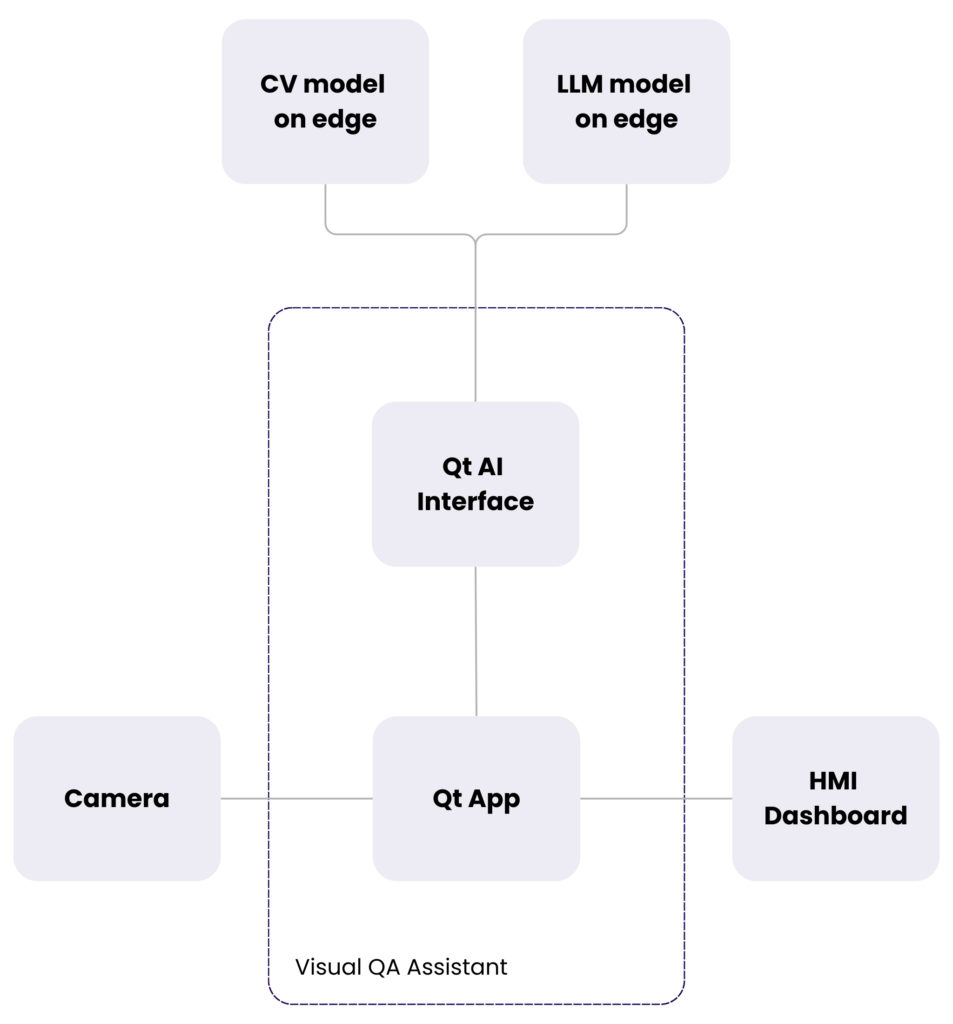
This stack allows the tool to operate as a fully self-contained, modular, and scalable inspection solution, combining AI intelligence, explainable insights, and a modern industrial HMI into a single, edge-deployable package.
Qt as the go-to foundation for edge AI and industrial HMI
Qt serves as a hub for edge AI, seamlessly connecting visual inspection, local LLM inference and an industrial HMI within a single, cloud-independent framework. Qt unites cameras, AI models, and natural language explanations to create a coherent system.
It also provides operators with explainable AI that they can immediately understand by replacing abstract heatmaps with clear visual overlays and plain-language insights delivered through an intuitive UI.
Finally, it gives a reference architecture for original equipment manufacturers and integrators, enabling the integration of custom models, parts, and machines while maintaining the same Qt-based HMI and application logic.
Inside the assistant architecture
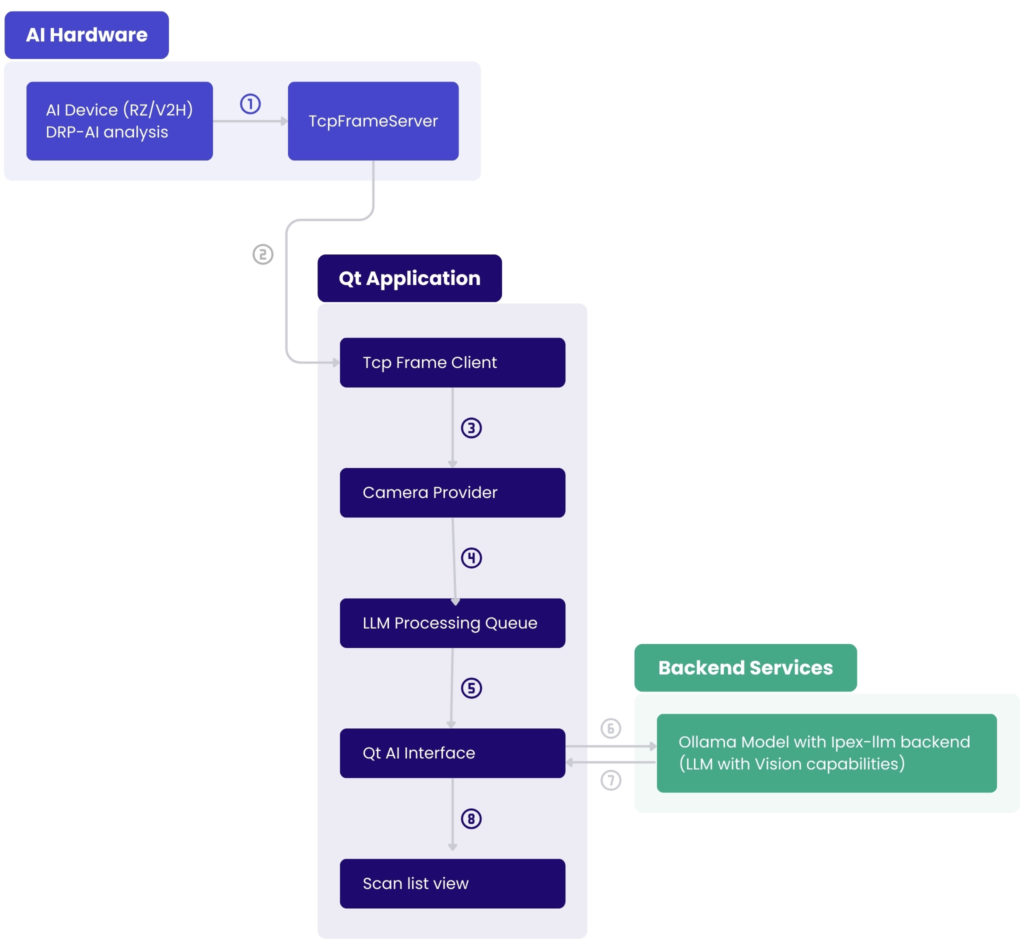
When it comes to the application architecture, the Visual QA Assistant is built on a modular, edge-focused architecture that is designed to enable real-time defect detection and provide explainable AI feedback. Camera frames are captured and analysed immediately by a crack segmentation model, which highlights any defects detected and sends the annotated frames to a TCP server. A TCP client on a connected machine then receives these frames, along with information about any defects detected. The CameraProvider module then retrieves the frames for live display, providing operators with an instant view of the inspection. Defect-containing frames are placed in a processing queue and sent sequentially to the Qt AI interface, which forwards them to a locally hosted Ollama server. The LLM analyses each frame and returns a natural-language description of any visible damage.
The results are finally presented in the application’s scan list view, combining visual overlays on the frames with clear textual explanations to provide operators with actionable insights in real time.
Over to you
Our assistant demonstrates how artificial intelligence, explainable inspection and modern Qt-based HMIs can be developed into practical solutions. Built with real industrial constraints in mind, it can be seamlessly integrated into end-of-line product inspection, incoming component quality checks, assembly verification, and maintenance and service quality audits. This is possible even in demanding environments, such as those in the consumer goods manufacturing industry.
As a Qt Premium Partner, we build on a proven Qt and edge technology stack and regularly present the assistant as a live demo on Qt’s exhibition stands at major industry events, including SPS in Nürnberg and Embedded World 2026. There, its physical setup, real-time defect detection, and plain-language explanations have been very well received by OEMs, system integrators, and QA professionals looking to modernise inspection processes.
If you are interested in seeing how this approach works in practice or building intelligent, explainable QA systems yourself, take a look at our job offers and join our team of experts!
About the author
Przemyslaw Krzywania
HMI Director